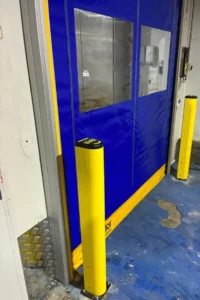
When it comes to protecting people, machinery, racking and infrastructure in busy industrial environments, safety barriers have an important job to do. But what actually happens when that barrier is put to the test and takes a significant hit?
For many years, steel has been the traditional choice for impact protection in warehouses, manufacturing facilities, distribution centres and other industrial environments. It looks strong, feels solid and provides a physical separation between vehicles, pedestrians and valuable assets.
However, when it comes to impact protection, rigid doesn’t always mean better.
Flexible safety barrier systems such as DEFLEX take a different approach. Rather than simply resisting an impact, they are designed to absorb impact energy, flex under force and recover their shape.
What happens when a steel barrier is hit?
Steel barriers are rigid by nature. When a forklift, pallet truck or other workplace vehicle collides with a traditional steel barrier, the force of that impact has to go somewhere.
Depending on the severity of the collision, the barrier can bend or become permanently deformed. The impact can also place considerable stress on the fixings and the floor where the barrier has been installed.
This can potentially lead to damaged fixings, concrete floor damage or a barrier that needs to be repaired or replaced.
There is also the ongoing maintenance associated with steel. In demanding industrial environments, painted steel barriers can become scratched and chipped over time. Exposure to moisture and other environmental conditions can also create the potential for corrosion.
Keeping steel barriers looking highly visible and in good condition can therefore mean repainting, repairing or replacing damaged sections throughout their lifetime.
How is DEFLEX different?
DEFLEX flexible safety barriers are engineered to behave differently when they take a hit.
Instead of remaining completely rigid, the barrier is designed to flex under impact and absorb energy. Following an impact, the material can recover towards its original shape rather than simply remaining bent or deformed.
This ability to flex can also help reduce the force transferred into the floor and fixings, potentially reducing the secondary damage associated with an impact.
In a busy facility where forklifts, pallet trucks and other moving equipment operate every day, this can be a significant advantage.
Why choose DEFLEX flexible safety barriers?
DEFLEX provides a number of benefits for industrial and warehouse environments:
- Impact energy absorption: Designed to absorb impact energy rather than transferring the full force through a rigid barrier.
- Flex and recovery: The barrier can flex when struck and recover following an impact.
- Reduced potential for floor damage: By absorbing energy, flexible barriers can help reduce stress on floors and fixings.
- No rust or corrosion: Unlike steel, the polymer material does not suffer from traditional rust or corrosion.
- No chipped paint: Colour is integral to the barrier, removing the need for ongoing repainting due to chipped or scratched paint.
- High visibility: DEFLEX barriers are designed to stand out in busy environments.