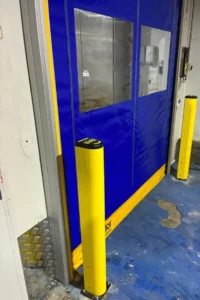
In busy warehouses, manufacturing facilities, coolrooms and distribution centres, even a relatively small impact from a forklift, pallet truck or trolley can result in costly damage.
Walls, racking, equipment and other infrastructure positioned around busy traffic areas can be particularly vulnerable. Repeated knocks can lead to damaged surfaces, ongoing repairs and unnecessary maintenance costs.
DEFLEX® Guardrails provide a durable, low-level industrial barrier solution designed to protect vulnerable areas from everyday workplace impacts.
Installed at floor level, DEFLEX Guardrails create a highly visible protective boundary between moving equipment and the assets you need to protect.
What are DEFLEX Guardrails?
DEFLEX Guardrails are part of the DEFLEX flexible impact protection range supplied and installed by Industrial Safety Barriers.
Rather than relying on the rigidity of traditional steel protection, DEFLEX uses a flexible PVC construction designed to absorb impact energy. When the barrier is struck, it flexes under the force before returning to its original shape.
This is an important difference in busy industrial environments where occasional contact with forklifts, pallet trucks and other workplace equipment can happen.
Instead of every impact potentially resulting in a bent barrier, damaged floor fixing or costly repair, DEFLEX is designed to manage the impact and continue providing protection.
Low-level protection where it is needed most
The DEFLEX GR150 Guardrail is a heavy-duty, low-height barrier system with an overall height of approximately 200mm.
Its low-profile design makes it particularly useful for protecting vulnerable areas at floor level without creating an unnecessarily large barrier within the working environment.
DEFLEX Guardrails can be installed along areas such as:
- Internal walls
- Coolroom walls
- Behind and around racking
- End walls
- Equipment and machinery areas
- Other vulnerable low-level infrastructure
This makes the system particularly suited to environments where forklifts, trolleys and materials-handling equipment regularly operate close to walls and other valuable assets.
Designed to absorb impact
One of the biggest differences between DEFLEX and conventional rigid barriers is the way the system responds when it is hit.
Traditional steel barriers rely heavily on rigidity. When significant force is applied, the barrier can bend or deform